Every treatment treated as its own search market.
A single specialist in central Poznań, competing with salons that buy ads. The website stopped being a brochure with a price list and became six separate answers to six separate searches.
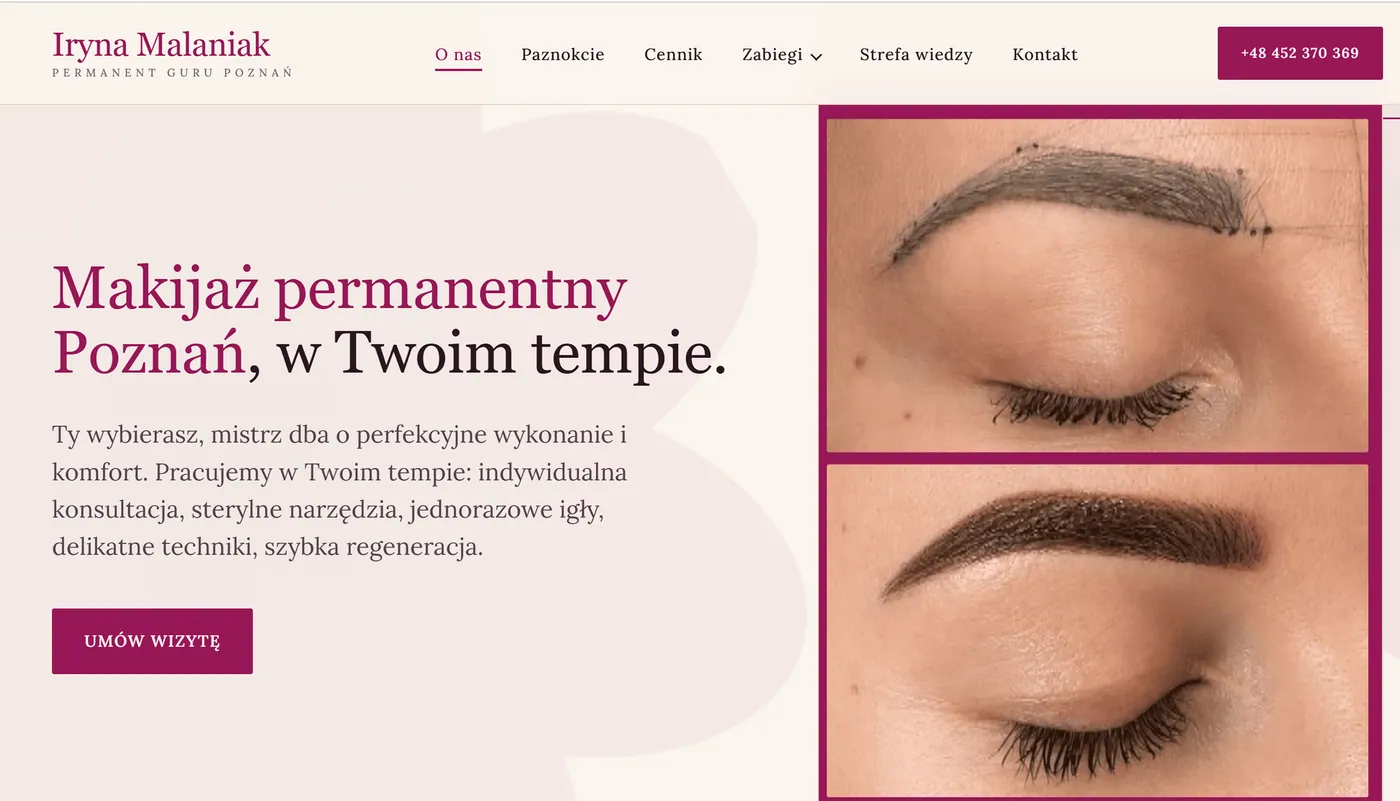
Where it started
Permanent makeup is a high-consideration purchase. Someone is letting a stranger put pigment into their face, and it stays there for a year or more. Nobody books that on impulse - they research for weeks, compare healed results, and arrive with a list of fears.
The studio had the harder half already: the skill, the sterile setup, the healed work. What it did not have was a way to be found by someone typing makijaż permanentny brwi Poznań at eleven at night - or anything on the page that answered the questions they were about to send by Instagram DM instead.
A price list tells you what something costs. It does not tell you whether you are the kind of person it is for.
The approach
The instinct with a treatment menu is to put everything on one page and link it to a price list. That page can only ever rank for one thing, and it answers nobody's specific question well.
So each treatment was treated as a separate market with a separate page, written for the search that leads to it and the doubts that come with it:
- Brows - microblading, powder brows and combination technique, separated because people search for them by name and have firm opinions about which one they want.
- Lips - where the real question is about swelling, colour settling and how it looks in week one versus week four.
- Eyeliner - the treatment with the most fear attached, so the page carries the most reassurance.
- Removal - a rescue search, usually urgent, usually after someone else's work. Entirely different intent, entirely different page.
- Lamination - brow and lash, the lower-commitment entry point that brings people through the door the first time.
- Reconstruction after alopecia - a medical-adjacent need, searched in completely different words, and the reason a shared page would have failed.
The nail side of the studio - manicure, pedicure, extensions, nail art - sits on its own track, because it serves a repeat-visit rhythm rather than a once-a-year decision.
Trust before the form, not after it
The questions that arrived as DMs got promoted to the page itself. Does it hurt. How long does it last. What does the healing week actually look like. What happens if the colour goes wrong. Who is holding the needle, and what are they qualified in.
That became the Knowledge Zone - the section that answers the research phase instead of pretending it does not happen. It also does the quiet work of ranking for every long-tail question a first-timer types before they are ready to book.
Booksy is where this market already has an account and a payment method. Fighting that with a custom booking flow would have cost conversions to prove a point. The site routes to Booksy, and keeps the contact form and a free consultation for the people who want to ask something first.
What got built
- Website and treatment architecture - a page per treatment, structured around search intent rather than the studio's internal categories.
- Local SEO foundation - technical setup, on-page work and the Poznań signals that decide whether a studio appears in the map pack.
- Google Business Profile - categories, services, photos and posts maintained as part of the system, not as an afterthought.
- Review workflow - asking at the right moment in the treatment cycle, so reviews arrive steadily instead of in bursts.
- Knowledge Zone - FAQ and education content that does double duty as trust-building and long-tail search coverage.
- Content and social calendar - healed results, technique explainers and studio posts on a rhythm the studio can actually sustain.
Layers live
Of the eight layers in the growth system, six are running. The order matters more than the count - each one makes the next cheaper.
Results
Numbers go here once GA4 and Search Console can back them - traffic, ranked queries, map-pack impressions and booking clicks, with the date range they cover. Nothing gets published on this page that cannot be pointed at in an analytics account.
Two things are already observable without a dashboard: the studio now has a page to send someone to for every question that used to be answered by hand, and the review flow arrives on a rhythm instead of whenever someone remembers to ask.
"Working with Alena has helped us communicate more clearly about Permanent Guru and the services we offer. She takes the time to understand our approach and turns our expertise into content that feels natural to our brand. We especially appreciate her attention to detail and the care she puts into getting our voice right."
What is next
Analytics and attribution come first, because every claim on this page should eventually have a number behind it. After that, AI search and GEO - the same trust questions are increasingly answered by assistants before anyone reaches a website, and the Knowledge Zone is already most of the raw material for that.
Want the same system for your studio?
Tell me which treatments bring in the money and where you want to be found. I'll tell you which layer is missing.