When the portfolio is the sales page.
Nobody books a tattoo from a paragraph. They book it from an image that makes them think: that is the line, that is the hand, that is the person who can draw the thing in my head.
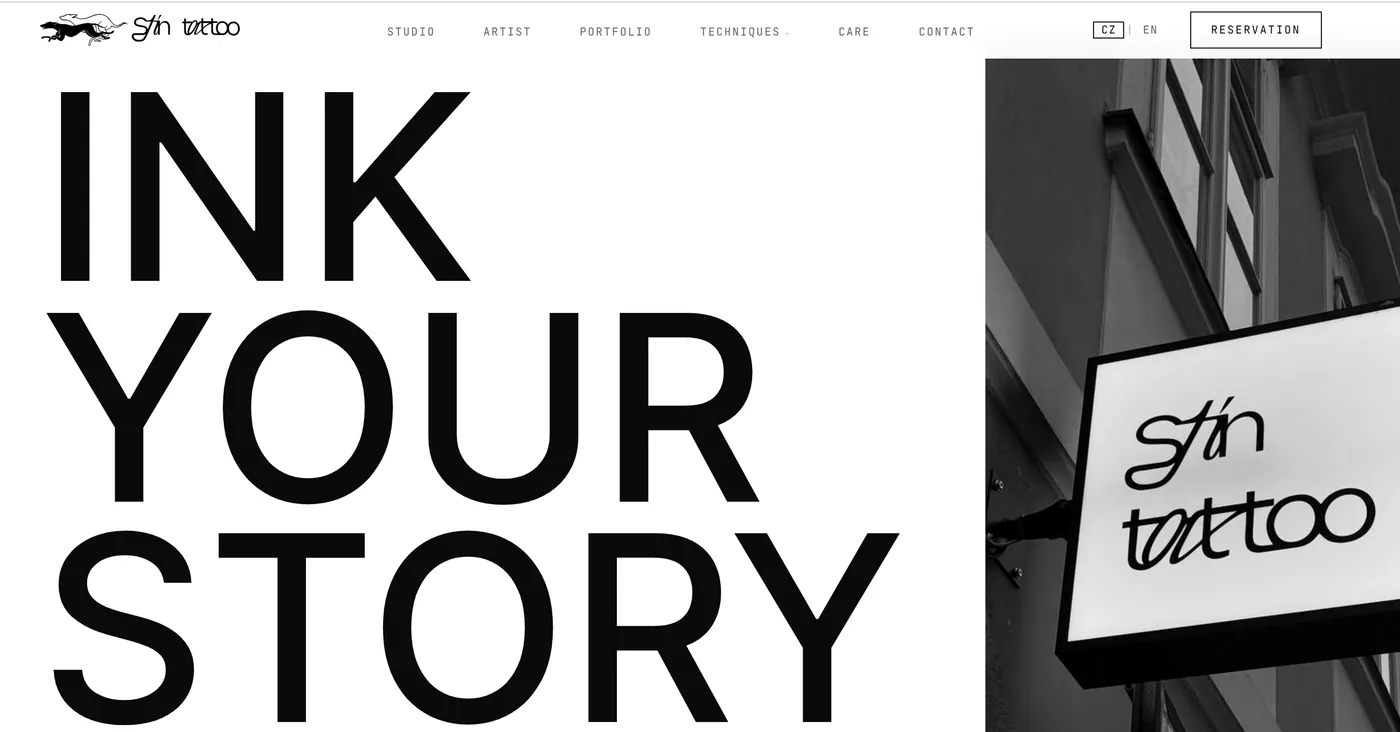
Where it started
A tattoo studio in Malá Strana has a specific problem. It sits in one of the most-walked districts in Europe, which sounds like an advantage and mostly is not: foot traffic there is tourists, and a tourist booking a permanent tattoo on a city break is the least valuable, least repeatable client a studio can get.
The clients worth building for are the ones who research a style for months, save references, and want a specific artist. They are searching by style - fine-line, ornamental, micro-realism - not by street.
Most tattoo sites are a gallery with a phone number. The gallery is right. The lack of structure around it is what costs bookings.
The approach
The portfolio was organised by style rather than by chronology, because style is the unit people search in and the unit they decide in:
- Fine-line and minimal - the largest search volume, the most crowded competition, and the style most often booked as someone's first tattoo.
- Ornamental and floral - highly visual, highly shareable, and the work that most often arrives through saved references.
- Graphic and illustrative - where the artist's own drawing voice is doing the selling, not the technique.
- Traditional and neo-traditional - a knowledgeable audience that judges a studio on whether the linework holds up.
- Blackwork and lettering - searched with different vocabulary and different expectations around cover-ups and scale.
- Micro-realism - colour and black-and-grey kept apart, because they are effectively two different skills and are compared as such.
Each style is a real landing point, so someone arriving from a style search sees that work first instead of scrolling a mixed feed hoping to find it.
The part most studios skip: aftercare
Aftercare content is usually a PDF handed over at the door. On the site it does three jobs at once: it answers the healing anxiety that stops people booking, it ranks for a genuinely high-volume set of searches, and it gives existing clients a reason to come back to the site - which is the cheapest reputation work a studio can do.
In an artist-led studio, the artist is the brand. Anna's profile carries the practice - the approach to custom design, the consultation, the atmosphere. "Cozy" is not decoration in this market: for a first tattoo, the feeling of the room is a large part of the decision.
What got built
- Website with style-led portfolio - the gallery structured as navigation, not as a scroll.
- Artist profile - the person and the working method, positioned as the reason to book rather than as biography.
- SEO and local search - style-based search terms alongside the Prague and Malá Strana signals.
- Aftercare section - practical guidance that doubles as search coverage.
- Consultation-first booking - a reservation form built for custom work, where the conversation has to happen before a price can exist.
- Bilingual build - English and Czech, for two audiences that search in different words and value different things.
Layers live
Results
To be published once Search Console has enough history - ranked style queries, entry pages by style, and consultation form completions split by language.
"[ CLIENT QUOTE - to collect ]"
What is next
Google Business Profile and reviews - in a district this dense, the map pack decides who gets walked into. After that, a steady rhythm of new work published by style, which is the closest thing a tattoo studio has to a content engine that maintains itself.
Visual business, invisible in search?
If the work is the product, the site's job is to make the work findable by the people already looking for that exact style.