The same method, with no walk-in trade.
No map pack, no reviews to collect, no impulse bookings. A buyer who compares four forwarders on reliability and insurance before emailing any of them. Eight layers, assembled in a completely different order.
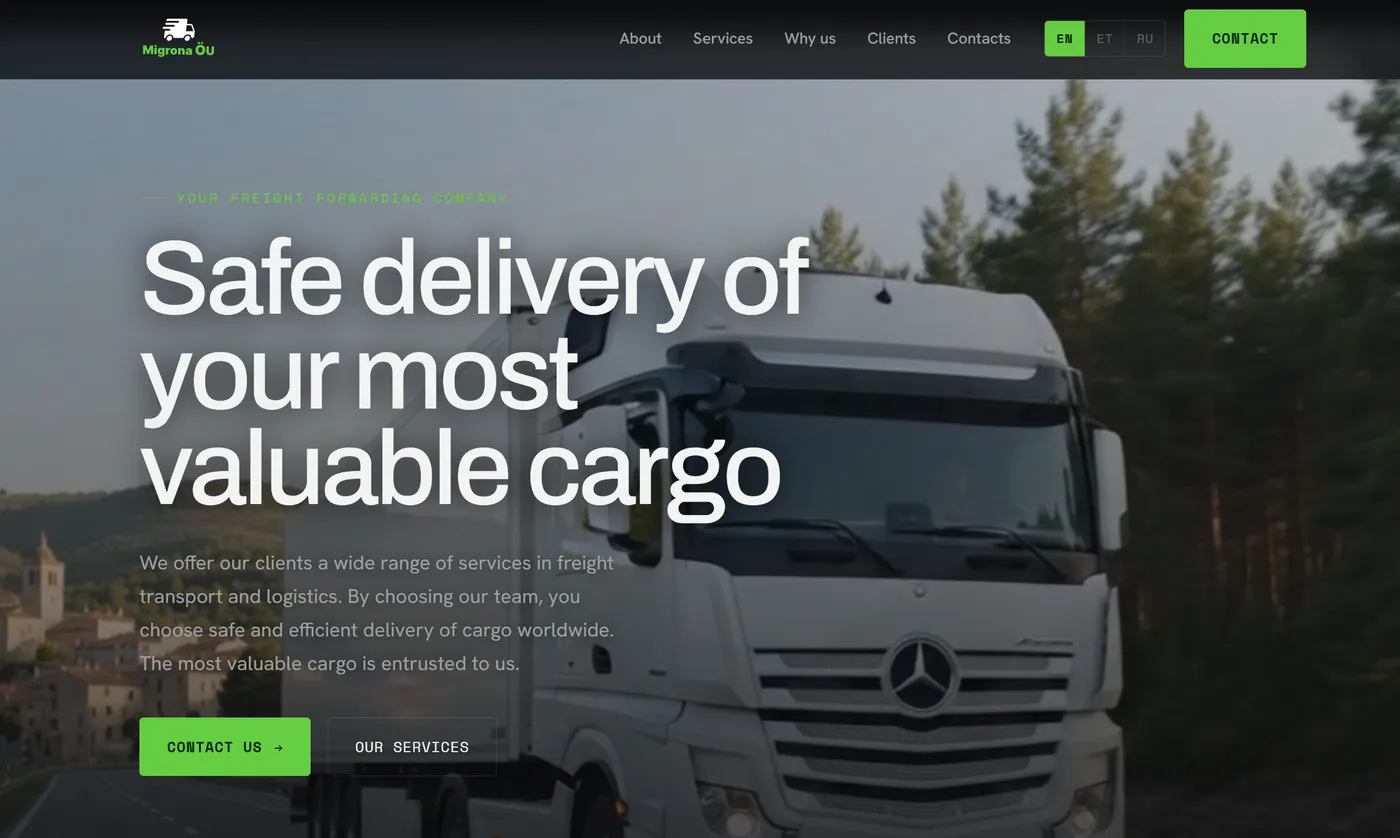
Where it started
This is the project in the portfolio that does not look like the others, which is exactly why it is here. Four beauty and wellness studios could be dismissed as one trick applied four times. Freight forwarding removes nearly every assumption those projects rely on.
There is no walk-in trade and no Google Business Profile worth optimising. Nobody leaves a five-star review for a pallet that arrived on time - they simply book you again. The buyer is a logistics manager or a business owner with cargo to move, comparing three or four forwarders on reliability, documentation competence and whether the cargo is insured. The decision is made before anyone picks up a phone.
In B2B logistics the website is not the salesperson. It is the reference check the buyer runs before they are willing to start a conversation.
The approach
The layer that carries a beauty studio - local search - is close to worthless here. The layers that matter move to the front: credibility, service specificity and language.
Services stated precisely enough to be quoted
A freight buyer does not search for "logistics". They search for the exact shape of their problem, and a vague services page disqualifies a forwarder immediately. So each service stands on its own terms:
- International road freight - the core service, and the one the routing and hub network has to make credible.
- Groupage - part-load consignments, a completely different buyer from someone booking a full truck, with different price sensitivity.
- Oversized cargo - the specialism that separates capable forwarders from brokers, and the search with the least competition.
- Vehicle transport - its own market, with its own vocabulary and its own anxieties about damage in transit.
- Customs clearance and documentation - for Baltic and post-EU-border routes this is frequently the reason a forwarder is chosen at all.
- Cargo insurance and warehousing - the questions a serious buyer asks third, and the ones that decide it.
The hub network is the proof
Rotterdam, Magdeburg, Vilnius and Kyiv are not decoration on a contact page. To a buyer, that list answers the only question that matters early on: can you actually move my cargo on my corridor, or are you going to subcontract it to someone who can? The network is presented as operational capability rather than as an address list.
English is the contract language, Estonian is the home market and the regulatory one, Russian is the working language across a large part of the corridor this company serves. For a forwarder, language coverage is not an accessibility nicety - it is a signal about who you can actually do business with.
Trust, adapted for B2B
The beauty projects answer "will this hurt and will it look right". This one answers "what happens if my cargo is damaged, who handles the paperwork at the border, and are you insured". Same principle - the objection goes on the page, before the contact form - with entirely different objections.
What got built
- Website and service architecture - each freight service made findable and specific enough to be quoted against.
- B2B positioning - capability and reliability foregrounded, since the buyer is qualifying a supplier, not browsing.
- Multilingual build - English, Estonian and Russian, matched to how the corridor actually operates.
- Trust and credentials - insurance, customs competence and the hub network presented as the reasons to shortlist.
- Enquiry route - a direct path to a person, because a freight enquiry is a conversation about a specific consignment, not a booking form.
Layers live
Note how different this checklist looks from the studio projects. That is the point - the system is an order of operations, not a fixed package.
Results
B2B freight has long sales cycles and low enquiry volume, so the honest metrics here are enquiry quality and ranked service-level queries rather than traffic. Published once there is enough history to mean anything.
"[ CLIENT QUOTE - to collect ]"
What is next
Corridor and route content is the largest remaining opportunity - pages built around specific lanes, such as Estonia to the Netherlands or Baltic to Ukraine, which is how freight demand is actually searched. Then service-level SEO for oversized cargo and customs clearance, where the competition is thinnest and the buyer is most committed.
If the method only worked for beauty studios in Poznań and Prague, it would be a niche, not a method. Freight forwarding shares none of the surface features of those projects and still responds to the same discipline: find out how the demand is actually phrased, build the structure to match it, answer the objection before the form, and only then worry about the design.
B2B, long sales cycle, technical buyer?
The website will not close the deal. It decides whether you make the shortlist - which is the harder half.