Case study · Poznań
Massage4You: a massage studio SEO case study from Poznań
Massage4You offers forty-odd treatments across bodywork, face, Thai and apparatus therapy. The range was never the problem. A first-time visitor had to read all of it to find one treatment, so I rebuilt the menu around how people search.
Last updated: · By Alena Porokh
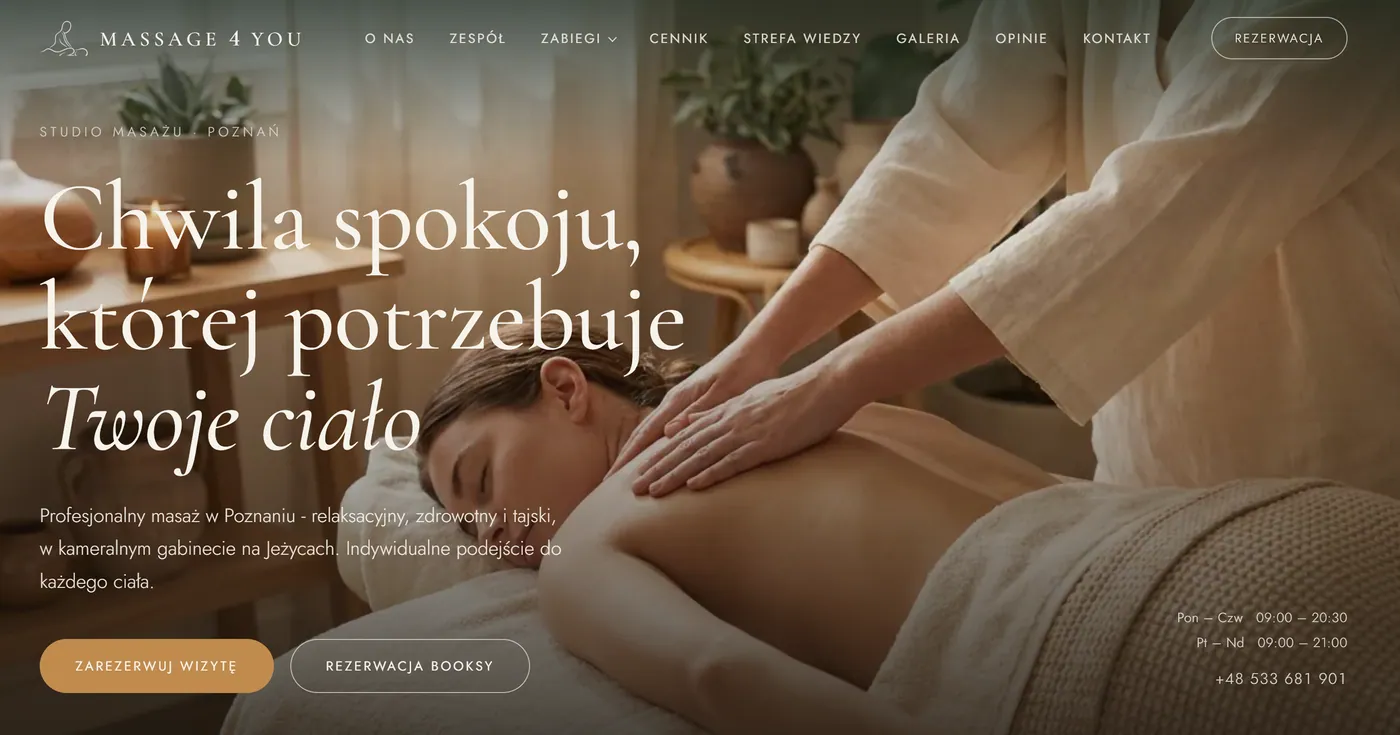
| Client | Massage4You |
|---|---|
| Industry | Massage & wellness studio with a team of therapists |
| Location | Jeżyce, Poznań, Poland |
| Languages | Polish and English, for local clients and relocated residents |
| What I did | Website and service architecture, booking UX, local keyword targeting, bilingual build, team, gallery, reviews, knowledge hub and gift voucher sections |
| Status | 6 of 8 growth layers live; analytics and AI search planned |
| Live site | massage-4-you.com (opens in a new tab) |
| Opening | Seven days a week |
In short: the treatment menu now has four entry paths: by problem, by technique, by occasion and apparatus treatments. Face work has its own destination. The English version is written for newcomers, not translated.
What was the problem?
The studio lost people at the menu, and it competed for the same three generic phrases as every other massage studio in Poznań. The dozens of specific searches people actually type went unanswered.
Someone arrives with a stiff neck and a two-hour window on Saturday. They meet a flat list that puts deep tissue, Kobido, Thai foot massage, lipolaser and presotherapy side by side. All of it is real expertise. None of it helps them choose.
Range is an asset on a price list and a liability on a homepage. The job was to keep the first without paying for the second.
What I built
I built a website that sorts the full treatment range into paths a first-time visitor can follow, a shorter booking route and a bilingual structure. Supporting sections each have a job.
- Website and service architecture. The full treatment range reorganized into clear paths.
- UX and booking flow. The route from "my back hurts" to a booked slot cut down to as few decisions as possible.
- Local keyword targeting. Technique names, body parts and district-level searches, instead of only the generic city phrase.
- Bilingual build. Polish and English versions, each written for its own audience.
- Supporting sections. Team, gallery, reviews, a knowledge hub and gift vouchers, each with a clear purpose.
Why organize treatments by how people arrive?
People describe their need before they know the treatment name. A menu organized by the studio's internal categories makes them translate; a menu organized by problem, technique and occasion meets them where they start.
The menu now has four entry paths:
- By problem. Back pain, tension, recovery after training, swelling. This is how most first-timers describe what is wrong.
- By named technique. Kobido, Thai, hot stone, lymphatic drainage, deep tissue. People who search by name already know what they want and often book the same day.
- By occasion. Couples massage and gift vouchers. A different buyer, who is often not the person receiving the treatment.
- Apparatus treatments. Endosfera, presotherapy, lipolaser and radiofrequency. They sit on their own track because they compete with clinics, not with massage studios.
Why does face work have its own section?
Face treatments attract a different search, a different price expectation and often a client who never books body work. Buried under body treatments, they would stay invisible to that client.
Kobido, transbuccal and sculptural massage were pulled out into their own destination.
Why two languages instead of one translated site?
Poznań has a large international population, and English speakers search for massage differently. Many do not know the Polish name of the technique they want. Many are choosing a studio in a new city for the first time.
The English side is built for that person. It is not a translation layer over the Polish site.
Why the team section matters
In a studio with a team, people book a person as much as a treatment. The team section lists each therapist's specializations, so someone looking for a specific technique lands on the person who performs it.
Which growth layers are live?
Six of eight layers are running. Analytics comes next, so each treatment page can be judged on its own.
What are the results so far?
No traffic or booking figures are published yet, because analytics is still being set up. Numbers will appear here with the date range they cover.
What will be measured: ranked queries per treatment, entry pages on the English side, and completed bookings by path.
What comes next?
With the Google Business Profile and review requests running, analytics is the next layer. It will let each treatment page be judged individually, and the map pack be judged on bookings rather than impressions.
Services used in this project
- Web design for service businesses: menus and site structure built around search demand.
- Local SEO for service businesses: technique, body part and district-level search coverage.
- Google Business Profile optimization: profile setup and a steady review process.
Too many services, not enough bookings?
Usually the range is not the problem. The order it is presented in is. Tell me what you offer, and I will show you where visitors drop off.